t2bfotomediatitolomedio

Perverse Sheaves and their Categorification in Geometry and Representation Theory

July 13-17, 2026

Call for applications: December 2, 2025 - March 15, 2026, via the VIU website

The use of perverse sheaves lies at the core of Geometric Representation Theory. It has allowed mathematicians to solve hard algebraic or representation-theoretic problems by identifying suitable spaces that encode crucial information and by using them to translate the initial problem into geometric terms. The aim of this Summer School is to introduce graduate students working in Algebraic Geometry, Representation Theory, or Topology to perverse sheaves and their categorification (perverse schobers), and some of their recent important applications.

The theory of perverse schobers represents a profound advancement in higher categorical geometry and representation theory. A perverse schober is a categorification of the classical notion of a perverse sheaf, replacing sheaves of vector spaces with sheaves of categories. This framework provides a powerful tool for studying moduli problems and categorical structures in algebraic and symplectic geometry.

Perverse schobers have found diverse applications across algebraic geometry, topology, and representation theory. For instance, they have been instrumental in the study of birational geometry and derived categories, particularly in the context of flops. They also play a key role in the study of the derived categories of quotient stacks from the viewpoint of Geometric Invariant Theory (GIT). Additionally, perverse schobers have been applied to classical problems, such as studying the non-rationality of certain varieties.

One of the most significant applications of perverse schobers lies in their connection to homological mirror symmetry, Fukaya categories, and cluster theory. These connections bridge algebraic geometry, symplectic geometry, and representation theory, revealing deep relationships between categorical structures and geometric phenomena. For example, perverse schobers provide a natural framework for understanding wall-crossing phenomena in mirror symmetry, further enriching the interplay between these fields.

The study of perverse sheaves, perverse schobers, and their interplay with geometry, algebra, and representation theory is currently an extremely vibrant and promising area of research. The techniques involved are highly sophisticated, making it challenging for early-career researchers to familiarize themselves with this rapidly evolving field without proper guidance.

Scientific Coordinators
Giovanna Carnovale, University of Padova
William Donovan, Tsinghua University
Francesco Esposito, University of Padova
Martina Lanini, Tor Vergata University of Rome
Francesco Sala, University of Pisa

Faculty
Agnieszka Bodzenta-Skibińska, University of Warsaw
Merlin Christ, University of Bonn
Francesco Esposito, University of Padova
Luisa Fiorot, University of Padova
Daniel Juteau, LAMFA UMR CNRS 7352, CNRS & Université de Picardie Jules Verne
Paul Wedrich, University of Hamburg

Who is it for?
The Summer School is intended for PhD students, early postdoctoral fellows and junior researchers, working in areas related to Algebraic Geometry, Representation Theory, and Topology.

Topics
- Derived categories and perverse sheaves
- Categories of Soergel bimodules
- Spherical functors
- Perverse schobers

Learning outcomes for participants
The theory of perverse sheaves and their categorification is extremely deep and sophisticated. This Summer School aims to raise awareness of the strength of the theory and equip participants with the necessary background and tools to engage with this topic during its period of rapid expansion.

Credits
A Certificate of attendance will be issued at the end of the course.
Number of ECTS credits allocated: 2

The Program will admit up to 30 student participants.

Fees
Students of VIU member universities:
€ 100 incl. VAT
Students of other universities:
€ 200 incl. VAT

The fees will cover tuition, course materials, lunches in the VIU cafeteria and social events.
Student participants will be responsible for covering their own travel expenses to and from Venice, accommodation, and local transportation.

VIU Alumni are eligible for a reduced fee.

20 scholarships are available to cover the accommodations costs on campus. Depending on the outcome of pending funding applications, additional resources may become available to support travel expenses. Students should indicate in the application form if they wish to be considered for these scholarships.

PhD candidates and post-docs from universities in EU universities may be eligible for Erasmus+ mobility grant support. Candidates should consult the International Office in their own university for information about the calls for applications for funding as well as for possible scholarships. VIU will provide any supporting documentation requested for such applications. Contact VIU Erasmus office: erasmus@univiu.org

Applicants must submit the application form, a letter of motivation – which should include a brief description of the candidate’s research interests, a curriculum vitae and a photo.

For further information, please download the brochure or write to: summerschools@univiu.org


This Summer School is supported by

 Logo Tshinghua

Yau Tsinghua


PD DM


Tor Vergata


compositiologo

Pre-registration open for 1st semester 2021-22

The online pre-registrations for the 1st semester AY 2021-2022 opened on May 3 and will close on September 8, 2021. The link to the pre-registration form is published in the Globalization Program section of the VIU website, in a white box at the side of the pages.

N.B. The Students need to pre-register to VIU portal in order to receive the login and password necessary to login to their personal page and to register for courses.
Registrations for courses open on July 21, 2021.

Academic calendar:
Orientation week September 6-10
Opening Ceremony September 9
Courses begin September 13
Midterm break November 1-5
Courses end December 10
Exam week December 13-17
Closing Ceremony December 16

National holidays November 1, December 8
Municipal holiday November 21

Accommodation
Students have the possibility to request help in finding accommodation in Venice. Places are limited and assigned on a first-come-first-served basis.
There are two accommodation options:
1 - VIU campus: dorms on San Servolo island
2 - A place in apartments in the city

Before requesting for accommodation, please read carefully the info on accommodation and the Student accommodation guidelines on our website (link), containing the procedure of request and useful details on accommodation options, prices and deadlines.
Deadline for application: June 3, 2021.

The accommodation form will be accessible from the personal page after logging in the VIU website (login link in homepage).

Scholarships
Students can apply for a RED (Residency-Excellence-Diversity) Scholarship, awarded to talented students to contribute to the cost of living in Venice for a semester and to promote excellence and diversity in the Globalization Program.
Deadline to apply: June 3, 2021.
Link
The online form will be accessible from the personal page after logging in the VIU website.

Prof. Agostino De Rosa | Iuav University

Italian
Degree in Architecture at the Federico II University of Naples (Italy), specializing with a three-year PhD on the subject of  the representation of light and shadow in Sino-Japanese religious figurative and philosophical cultures.

The field of research and study is related to the History and Theory of Representation Methods, both in West and in Far East cultures. These fields of study have poured into teaching at the VIU: the courses I have held over many years have focused on comparative studies between different and multicultural approaches in the representation of two philosophical and existential categories, space and time.

I chose to teach at VIU because I was initially invited by the Dean of my faculty, but in reality, I wanted my studies and my research to have a bigger audience of listeners and an opportunity for comparison with students and colleagues from other disciplinary fields and other countries.

Teaching at the VIU is an extraordinary experience for many reasons: first of all, logistically. Reaching San Servolo is a real journey out of the secular world, and arriving on the island is equivalent to entering a microcosm where, however, the macrocosm converges. Precisely the interdisciplinarity offered by the academic programs and the possibility of comparing with colleagues and students from the most various backgrounds corresponds to a real personal and academic enrichment.

Because it is an experience of human and professional growth and maturation. You can meet students and colleagues with very different knowledge and fascinating approaches to research. In short, teaching at the VIU helps improve one's place in the world

It was interesting and enriching for me to receive insights from students who came from such different cultures and traditions. Teaching at VIU was a way of learning more about myself and my profession.

Apart from the discussions at the end of the lesson, which were always smart and engaging, the best moments were those in which, while waiting for the lesson or after its end, it was possible to speak freely with the students. An unforgettable experience.

I participated in the [Erasmus+] exchange program with Tel Aviv University, at The Yolanda and David Katz Faculty of Art, where I gave lectures and seminars for the local Doctoral School. I was able to appreciate the high scientific level of that institution and collaborate in seminars and debates of the highest level, a unique opportunity also to show the results of my academic research.

The desire was to deepen the comparison with an academic institution, Tel Aviv University, very renowned and able to expand my cultural and human horizons. If I had the chance I would like to repeat it, since protocols of international scientific collaboration and friendships with formidable and highly skilled colleagues were born.

-- 


Agostino De Rosa's teaching at Tel Aviv University was supported by the Erasmus+ project: 2019-1-IT02-KA107-062057, in the context of the Erasmus+ Mobility Consortium 2017-1-IT02-KA108-036012. 


EU flag Erasmus vect POS 30pc

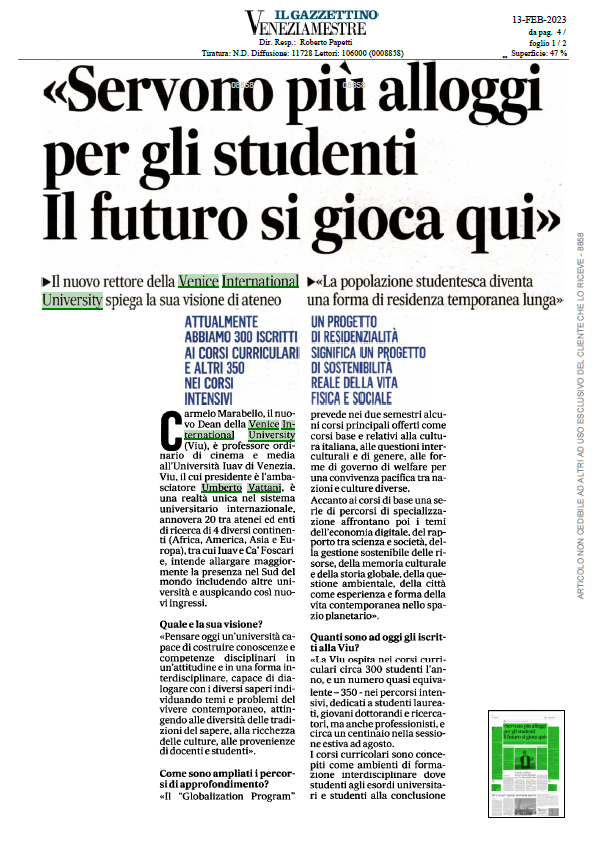
Prof. Carmelo Marabello


Dean of Venice International University since April 2022.

Carmelo Marabello is full professor of Film and Media Studies at the Università Iuav di Venezia in the Department of Architecture and Arts, where from 2015 to 2021 he coordinated the Multimedia track of the Bachelor's Degree in  Fashion and Multimedia Design. He was a member of the Academic Senatus from 2018 to 2021 and is currently the Rector’s delegate for University Strategy.

Marabello teaches courses on Cinema and Contemporary Arts; Media Theory; Anthropology of Images; Expanded Cinema; Globalization and Media; Film, Lansdcape and Architecture.  His research interests include Filmology, Media Theory, History of Italian Cinema, Visual Culture and Artistic Practices, History of Photography, History and Theory of Visual Anthropology and Ethnographic cinema, Film Analysis as the practice of editing and reassembling film materials, Environmental Humanities.

Before joining the Iuav University in 2014 as an associate professor, Marabello was curator and programming director of the Taormina International Film Festival, and spent 10 years at RAI – the Italian public broadcasting company, where he authored, edited and directed various programs and projects. He returned to academia in the 2000s obtaining a PhD at the University of Bergamo, where he became a Researcher, a role that he fulfilled also at the Universities of Messina, Bolzano and the Bocconi in Milan. 


Interview with Prof. Carmelo Marabello, Il Gazzettino, February 13, 2023 (in Italian)

marabello intervista feb2023

Prof. Christof Mauch | LMU

from Germany

We interviewed Prof. Mauch to learn more about his experience at VIU in the Globalization Program.

“Sometimes you do have to adapt, because of the diversity of the students, also because for some of them it can be difficult to follow and you may need a break. So what happened recently for instance is that my students said, it was a beautiful sunny day, why don’t we go outside? We had to do something inside but we decided to go outside and we were sitting on the lawns of the island. We decided to discuss from an environmental history perspective the story of the lawn, of grass.”

“The dearest part of this program is the fact that we are all sitting on the same boat. And I don’t mean this only metaphorically but I mean it – it’s a small community and every day you come by vaporetto from San Zaccaria to San Servolo for ten minutes, and then ten minutes to go back. And there are the students, and professors, everybody sitting on the same boat. You can talk, professors talk to students, students to students, ecc. It is a small community and you get to know everybody within a short time.”

“I think everybody would gain a lot by being a professor here. Not only because of the internationality of the place, not only because of the beauty of the place. I mean, where can you teach on an island? But also because you can learn something about Venice that you can never learn unless you are here for several months. (…) If you live here for three and a half months, you are really involved with the city. It makes it enjoyable and a very memorable experience.”

Find out more about Prof. Mauch’s VIU experience in his interview.


Prof. Cristiano Guarneri and Prof. Gianmario Guidarelli | Ca’ Foscari University and University of Padua

Italians

We are both historians of architecture and city with a specialization in the early modern and modern period. This year at VIU we teach a course in urban history, focused on the impact of the modernity between seventeenth and eighteenth century in the biggest capital cities of the Western World. Of course, we will pay a particular attention to Venice too.

We joined VIU for a new and different experience in teaching, to stay in an international context with colleagues and students from all over the world. Furthermore, we specialize in the history of architecture in Venice, which has always had an international dimension since the Middle Ages: teaching at VIU allows us to test the universality of Venetian architecture with students from very different cultures.

Teaching at VIU is always stimulating and challenging. Classes are small (we know the students by name) and really heterogeneous on many points of view. We have students of different nationalities, European and non-European, coming from very different degree programs, from the social sciences and humanities to the hard sciences. If focused on a common ground, such as urban history, these differences brought by our students can create a surprising dialogue that literally break the boundaries of each one’s discipline broadening our mind and the understanding of the phenomena.

We would recommend other professors to teach at VIU to have an international teaching experience, in a multicultural context of very high scientific value. In this sense, VIU perfectly interprets the democratic and cosmopolitan vocation of Venice which has always been a crossroads of cultures, languages and ideas. The VIU campus is a universal “square” and living in Venice during the teaching period at VIU enriches this experience even outside the academic sphere.

Teaching to international students: first of all we would like the students to talk to each other and therefore to be able to actively participate in campus life as a meeting place for civilizations. We also want to stimulate students to ask ourselves some unusual and original questions, so that they can re-elaborate in a personal way the topics addressed during the lessons.

Differently from other professors that come from abroad, we normally teach here (at Ca’ Foscari University of Venice and University of Padua) and daily live Venice, which has been also the subject of many of our studies. So our best moments are when we explain the urban and architectural history of Venice, not only in the classroom but also in special on-site visits. We like to show very famous places, such as St Mark Square and the La Fenice Theater, and also unknown areas of Venice.

For the 1st semester of AY 2021-2022 our course would be in the new specialization track: History and memory. Although our course is listed under the new track, it has many contact points with almost all the other tracks. In particular, the course contributes significantly to the specialization track in Economics, Management and Digital Technologies Applied to Cultural Heritage, because it combines historical lectures with a workshop on the digital tools for the analysis of the urban history.

Prof. Eugenia Georges | Rice University

from the USA

We interviewed Prof. Georges to learn more about her experience at VIU in the Globalization Program.

“I think teaching to an international audience has been one of the things I liked most about teaching in VIU. There are many dimensions that I think quite exceptional and have been fascinating. One thing that I have enjoyed that has been unique is the international composition of the classroom. I have been able to draw upon students experiences, to promote discussion, we do comparative discussions about what is it like in your country and students can bring their own experience to the topics we are studying. Food is a natural, but also gender is too. So it is something that flows in the classroom.”

“It has been wonderful. It is always a challenge to move to a new city and discover basic things. Venice is a unique place and it has been a lot of fun learning how to do things here. I am learning too. In general it has been great.”

“Getting to know the students individually is the dearest part of my time at VIU. It is wonderful that the classroom size is as small as it is, because it provides a lot of opportunities to know the students very well. Because of that I get comfortable bringing them in into the conversation and students really appreciate that. ”

“The faculty who come here to teach are from different contexts as well, and it has been very rewarding to get to know them. One thing that I enjoyed very much is the co-curricular, which are opportunities to get out of the classroom and professors typically organize some kind of educational experience outside of the classroom for their class and faculty come along too. There are so many dimensions that makes it quite special. For me it has also been an opportunity for personal and educational growth.”

Find out more about Prof. George’s VIU experience in her interview.


Prof. Julia Safronova | European University at St. Petersburg

Russian

The sphere of my teaching in general is in intersection of memory studies, political history and history of Russian Empire. I have prepared two courses for students of VIU. Memory Studies. An Introduction is basic course for discussing the topic from very beginning. Memory and Media: between Pyramids and the Internet is a workshop designed to encourage creative teamwork, daring experiments and crazy projects focusing on material measurement of cultural memory and the processes of its transformation.
Besides of Memory studies my research interests are laying in history of Russian Empire in the second half of 19th century. My books are focused on the Emperor Alexander II, on the one hand, and revolutionary movement against him, on the other hand. Right now, I am writing the book about reading of illegal literature in the 1870s in Russia.

Teaching at VIU is a great chance to enrich my experience working in a big international team of professors and students. As a member of Department of history in European University at St. Petersburg I work with student training in Russian history. I hope students from different scientific fields and from around the globe can create a new level of multidisciplinary discussions in my classes. But in all honesty Venice is the best city in the world (after Saint-Petersburg of course).

I have created both courses thinking about team working. I do not want just to read lectures about theoretical problems of memory, media, etc. We will have to discuss classical texts of the memory studies indeed, but the focus of both courses will be on ideas how to use all these approaches in new researches. Some years ago my students and I were working on the project about memory of Feodor Dostoevsky in modern Russia. It was an amazing experiment resulted in a number of very good course projects which could be developed in articles for solid journals. I hope we can find the same topic for my international class in VIU.

Memory studies is a fast-developing interdisciplinary field which unites people from different spheres of social science and humanities. But more importantly it creates the new view on “obvious” things about our past we know from school books, films and mass culture. The most eloquent example of how Memory studies transform conventional perception of history is the book by Trevor-Rouper “The Invention of Scotland” we will read on introduction course. Many people who are fans of the film “Brave heart” or bagpipe music are shocked to know that “traditional Scottish culture” was in fact invented by the British in the 18th century. But more shocking is understanding that past still can be an instrument of antagonism and intolerance, wars of memory can lead to real wars. The idea of VIU is to create the bridge between diverse cultural backgrounds and histories. This skill can be crucial in today’s society.

European University offers an MA Program in Memory Studies. Due to my experience I can clearly see how useful such a diverse track may be for students who benefit from attending classes of different professors and comparing and combining various approaches to the past. In my opinion, courses in urban history, film studies, intercultural memory, representation of time and space etc. can be seen as pieces of the puzzle adding important details to the whole picture. Students are encouraged to use knowledge from all the track, and we can specify some elements of the syllabus together.


Prof. Kirsten Stirling | University of Lausanne

Scottish, but I have been teaching at the University of Lausanne in Switzerland for over 20 years.
English Literature, with a focus on the Early Modern period (16th-17th centuries). At VIU I taught two courses: "Shakespeare in Venice and Verona" and "Early Modern Print Culture in the Digital Age".

Ever since I learned that Lausanne was a partner of VIU I thought it would be a great thing to try! I was keen to teach in a different environment for a change, and to live in a different place for a semester.

My experience at VIU exceeded my expectations! I had an amazing time during my semester and would love to go back. Teaching students from such different cultural backgrounds, and with different academic specializations, made for a really interesting class. The Shakespeare class I taught was particularly special. A great group of students from very different backgrounds, very few of whom had studied Shakespeare before - and we ended up staging an abridged version of Romeo and Juliet, set in Korea, for the mid-term workshop! The setting of VIU on San Servolo is also unlike anywhere else I have ever taught and helps create the sense of community that we feel in the classrooms.

I recommended to my colleague because, the sense of community that I mentioned above is partly due to the fact that most of the students are spending just one semester in Venice and so they make friends very quickly among themselves. I think this adds to the goodwill of students in the classroom. But it's also great to meet colleagues from other fields and exchange ideas - I made some good friends among my colleagues during my VIU semester. We are encouraged to participate in field trips around Venice organized for the students and that was extremely interesting as well.

In my experience the cultural mix of the students made for a very nice classroom. Using English as a lingua franca put everyone on a similar level (as it happens I had very few native English speakers in my classes). The classes could be really enriched by students bringing knowledge and experience from their different backgrounds into the classes - in my print culture class I had quite a few Korean students who told me about early Korean printed texts, and in the Shakespeare class many students were interested in exploring Shakespeare adaptations in their own cultures.